The verdict
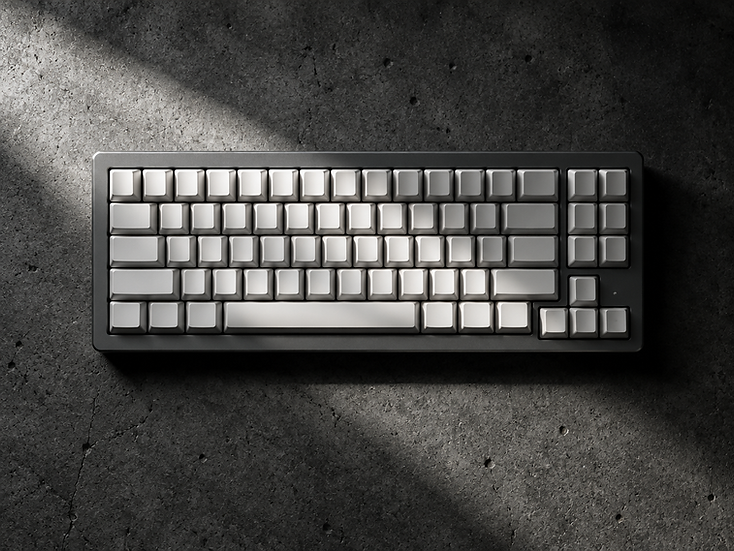
A gasket-mounted 75 percent board in a machined aluminium case, tuned well enough out of the box that most people will never open it. The software is the compromise.
First contact
The K7 arrives assembled, which is now the minority position in this market. The case is a single block of 6063 aluminium with a bead-blasted finish and no visible seam; the plate floats on gaskets, so the whole assembly has a small, deliberate amount of give. Keycaps are PBT with a slightly grainy texture and legends that are printed rather than moulded, which is the first place the price shows. The rotary knob is machined aluminium with a knurl that feels expensive and steps rather than turns smoothly. At 1.6 kilograms it does not move when you type hard, which is the entire point of a heavier case.
In use
Typing on the K7 is the reason to buy it. The gasket mount and the plate material produce a low, muted thock with no ping and no rattle, even on the spacebar, which is where cheap boards confess. Twenty-five days of eight-hour days produced no fatigue on 45-gram linears, and the stabilisers arrived tuned well enough that I never opened the case. The 2.4 GHz dongle showed no measurable input latency against a wired connection across three separate machines, including one with a dense USB hub. Battery ran nineteen days of working-hours use with the backlight off. The knob, mapped to volume, is genuinely useful rather than decorative.
What it gets wrong
The software is the weak link. Remapping lives in a browser-based configurator still labelled beta, it has dropped a saved layer twice, and there is no local offline editor. Mac users get a partially translated key layout map and two media keys that do nothing. The keycaps are thin PBT with printed legends, so the most-used keys will shine within a year. And the stepped knob, while pleasant, makes fine volume adjustments impossible: each detent is a fixed jump, and there is no press-and-hold ramp. None of these are dealbreakers, but they are the difference between a great board and a finished product.
The verdict
At 139 dollars the K7 is the easiest recommendation in this index. Nothing under 200 dollars types like it, and most boards at 300 dollars only match it. Buy it if you type for a living and want to stop thinking about your keyboard. Buy it if you have been curious about gasket mounts and do not want to solder anything. Skip it if you need serious remapping for a non-standard layout, if you want double-shot keycaps from the factory, or if you need a numpad. It is a tool with a slightly unfinished manual, and the tool is excellent.