The verdict
A purifier that does its job at a volume you can sleep through, spoiled by a consumables strategy that turns a 379 dollar appliance into a subscription.
First contact
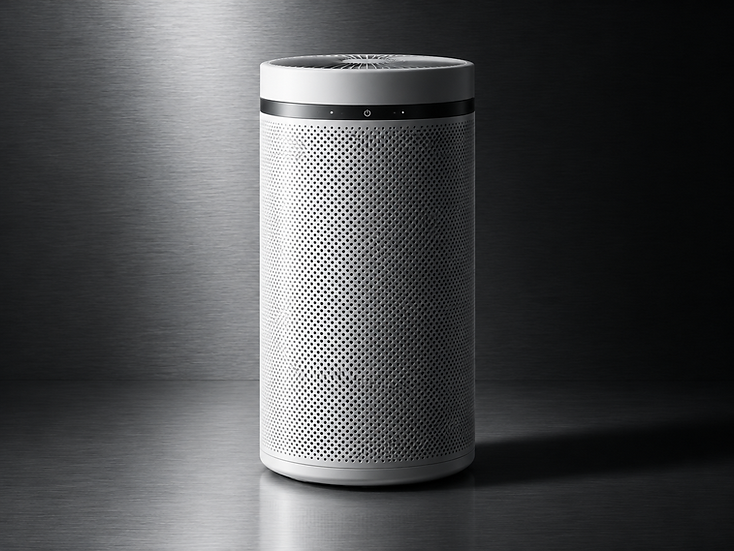
The P4 is a white cylinder wrapped in perforated steel with a single dark ring at the top that lights when you touch it. It is unusually well resolved for the category: the mesh is fine enough that it reads as fabric, the seam is invisible, and there is no branding on the front. The filter cartridge slides out on a single latch and comes out clean, which sounds trivial until you have vacuumed a pleated filter out of a cheaper unit. Controls are three touch points and one dial ring. It weighs 6.8 kilograms and sits on a felt base that does not scratch a wood floor.
In use
On its lowest setting it measured 22 dB at one metre, which is below the noise floor of a quiet room and effectively silent at the head of a bed. On high it moves enough air to clear a kitchen of cooking smoke in about eight minutes, and the particle readout tracked that honestly, dropping from 90 to single digits with a believable curve rather than a marketing cliff. Over twenty days the automatic mode never once ran at a level that interrupted a conversation. Power draw at the wall stayed under 5 watts on low, which is less than the standby draw of the television in the next room.
What it gets wrong
The economics are the problem. A cartridge is 89 dollars and the unit asks for one every five months, which means the first three years of ownership cost more than the appliance. Auto mode overshoots badly when it detects cooking: a pan of bacon sends it to maximum for several minutes after the air is clear, and there is no way to soften that response. Remote control requires an account, and the app is the only path to scheduling. The sensor is particle-based only, so it has no opinion about volatile compounds, which is where the carbon stage matters and where the readout gives you nothing.
The verdict
At 379 dollars the P4 is a good purifier with a bad consumables model. Its real achievement is acoustic: a machine this quiet, moving this much air, is rare below 500 dollars. Buy it if the unit will live in a bedroom or a small studio and you value silence over everything else. Skip it if you are optimising three-year cost, in which case a cheaper unit with 40 dollar filters wins on arithmetic, or if you want local control without an account. This is a beautifully made object with a subscription hiding inside it.